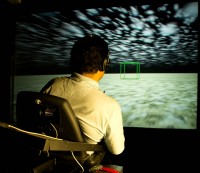
How do we best design locomotion interfaces for VR that provide “enough” physical motion cues (vestibular/proprioceptive) while still being effective, affordable, compact, and safe?
Despite amazing progress in computer graphics and VR displays, most affordable and room-sized VR locomotion interfaces provide only little physical motion cues (e.g., vestibular & proprioceptive cues). To provide a more compelling and natural sensation of being in and moving through virtual environments, and reduced motion sickness and disorientation, we design and evaluate novel approaches towards more embodied yet affordable, safe, and compact locomotion interfaces for VR. In particular, we design and investigate novel user-powered minimal motion cueing interfaces that can enhance self-motion perception in virtual reality.
Video of how such motion cueing could be applied in VR simulations
Below is an example of how one can control the self-motion simulated in Virtual Reality by simply leaning into the direction of intended travel using a leaning chair (Gyroxus). No motors, actuators, or complex motion cueing algorithms needed.
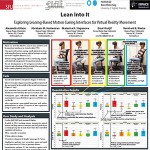
Below are 2 recent posters presented at IEEE VR 2017:
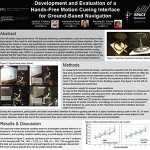
Click to view Poster
Media Gallery
[mediatags]motion-cueing[/mediatags]


