Comparing spatial perception/cognition in real versus immersive virtual environments: it doesn't compare!
Virtual reality (VR) is increasingly used in psychological research and applications – but does VR really afford natural human spatial perception/cognition, which is a prerequisite for effective spatial behavior? Using judgment of relative direction (JRD) tasks, Riecke & McNamara (Psychonomics 2007) demonstrated orientation-specific interference between participant’s actual orientation in an empty rectangular room and their to-be-imagined orientation in a previously-learned room. To test if VR yields similar interference, we replicated their study using a modified condition: We used an empty virtual (instead of real) test room presented on a 180°×150° video projection. After learning 15 target objects in a rectangular office, participants performed JRD tasks (“imagine facing X, point to Y”) while facing different orientations in the virtual test room.
Despite using identical procedures, seeing the virtual environment did not produce the same interference as a comparable real-world stimulus, suggesting qualitative differences in human spatial perception/cognition in real vs. computer-simulated worlds.
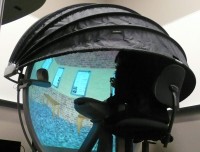
We are currently running follow-up studies to directly compare JRD performance in a real test room and a photo-realistic replica thereof, using our new 2560×1600 resolution Wheatstone Stereoscope. While some participants showed the expected effect in the real but not virtual environment, unexpectedly we also observed the reverse. We are currently running control studies to investigate potential underlying factors.
[mediatags]proj–Moura2009-JRDInVR[/mediatags]


