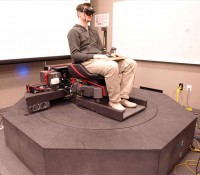
How important are physical motions for effective spatial orientation in VR?
Most virtual reality simulators have a serious flaw: Users tend to get easily lost and disoriented as they navigate. According to the prevailing opinion, this is because physical motion cues are absolutely required for staying oriented while moving. In this study, we investigated how physical motion cues contribute to spatial updating in a realistic and highly structured virtual environment, using a rapid point-to-origin paradigm without performance feedback.
After visually displayed passive movements along curved streets, participants were asked to point back to where they started. In some conditions they physically rotated with the curve, in others they only received visual motion cues. Results showed that physical motion cues did not affect pointing error or response time significantly. This suggests the possibility that physical motion cues might be unnecessary if visuals are realistic enough. Furthermore, two participants unexpectedly exhibited ‘non-turning’ pointing behavior, reacting as if they had not updated their headings during movements across all conditions. Implications and follow-up studies are discussed.
Below is a video of Salvar Sigurdarson’s first ever conference talk at the IEEE Virtual Reality conference entitled “Can physical motions prevent disorientation in naturalistic VR?”.
And here’s a more recent presentation from Bernhard on online spatial orientation study and the rather unexpected response patterns that we observed — and how we might be able to make sense of them.
[youtube miiPjAUb77Y]
Here’s the reference for the talk: Riecke, B. E., Stepanova, E. R., & Kitson, A. 2016. New response patterns in point-to-origin tasks depending on stimulus type and response mode. Talk presented at the International Meeting of the Psychonomic Society, Granada, Spain.
Which direction is the origin of motion for this visually simulated locomotion in Virtual Reality? The below video shows a visually simulated locomotion of a 2‑segment path in a simple virtual environment without any landmarks (i.e., just providing “optic flow”). Your pointing response can reveals whether you are a “Turner” or “NonTurner”, i.e., whether you tend to incorporate the rotation into your pointing response (and thus mental spatial representation) or not.
[mediatags]proj–SU-physMotion[/mediatags]


