
Biography
Daniel’s background is in computer science and psychology. He was studying the effect of visual motion illusions (vection) on spatial perception in virtual reality.
Projects
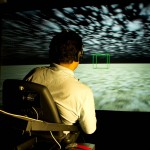
Lean and Elegant Motion Cueing in VR
How do we best design locomotion interfaces for VR that provide "enough" physical motion cues (vestibular/proprioceptive) while still being effective, affordable, compact, and safe? Despite amazing progress in computer graphics and VR displays, most affordable and room-sized VR locomotion interfaces provide only little physical motion cues (e.g., vestibular & proprioceptive cues). To provide...
Gyroxus Gaming Chair for Motion Cueing in VR
Can self-motion perception in virtual reality (VR) be enhanced by providing affordable, user-powered minimal motion cueing? Introduction & Motivation: Can self-motion perception in virtual reality (VR) be enhanced by providing affordable, user-powered minimal motion cueing? To investigate this, we compared the effect of different interaction and motion paradigms on onset latency and intensi...
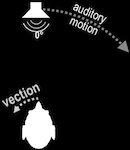
Embodied Self-Motion Illusions in VR
How can we provide humans with a believable sensation of being in and moving through computer-generated environments (like VR, computer games, or movies) without the need for costly and cumbersome motion platforms or large free-space walking areas? That is, how can we "cheat intelligently" by providing a compelling, embodied self-motion illusion ("vection") without the need for full physical mo...
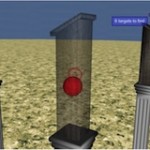
Navigational Search in VR: Do we need to walk?
Do we need full physical motions for effective navigation through Virtual Environments? Recent results suggest that translations might not be as important as previously believed, which could enable us to reduce overall simulation effort and cost Physical rotations and translations are the basic constituents of navigation behavior, yet there is mixed evidence about their relative importance for co...
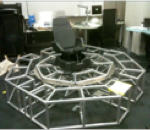
iSpaceMecha
Collaboration between the iSpace lab at SIAT and Mechatronics Undergraduate Interns to design and build a unique, virtual reality multi-modal motion simulator The iSpace program is centered on investigating what constitutes effective, robust, and intuitive human spatial orientation and behaviour. This fundamental knowledge will be applied to design novel, more effective human-computer interfaces ...
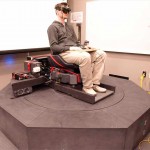
Spatial Updating With(out) Physical Motions?
How important are physical motions for effective spatial orientation in VR? Most virtual reality simulators have a serious flaw: Users tend to get easily lost and disoriented as they navigate. According to the prevailing opinion, this is because physical motion cues are absolutely required for staying oriented while moving. In this study, we investigated how physical motion cues contribute ...


