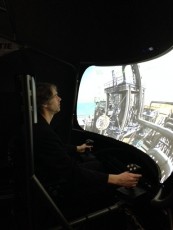
Using motion seats for enhancing locomotion and immersion in VR
How can we provide a “moving experience” through VR without having to use a full-scale motion platform?
Could a compact and relatively low-cost “motion seat” provide some of the same benefits, thus reducing cost, complexity, space & safety requirements?
Despite considerable advances in Simulation and Virtual Reality (VR) technology, it largely remains an open problem how to provide a convincing and embodied sensation of really being present and immersed in large virtual spaces, and navigating through them effectively without excessive disorientation and motion/simulator sickness. This is particularly true when the goal is to develop cost- and space-efficient solutions and physical space is limited, such that virtual navigation cannot be enabled by physically walking or moving-base motion simulators.
In collaboration with Christie, a large audio-visual and VR system company, we jointly perform research into innovative “motion seats” that allow for small-scale user motion and vibrations. The goal is to devise more compact and cost-effective ways to enhance the user experience (e.g., perceived realism, immersion, self-motion perception) as well as task-specific performance in simulators.
Initial qualitative research is used to identify key design decisions and outline requirements. This helps to guide the design and iterative refinement of both the motion seat and suitable experiments to investigate its effectiveness. Together, this will lead to a working prototype of a motion seat and demonstrator, scientific analysis and reports, and guidelines for possible future research and development. This project will enable and inspire more affordable yet effective simulators.
Reducing the reliance on large, heavy, and costly moving-base simulators can further enhance user acceptance, safety, and accessibility to wider audiences while reducing cost, space, and technical support needs.
This could provide benefits for both use single-user systems (e.g., arcades, home-based premium games, flight simulators or telepresence/remote operation systems) and multi-user systems (e.g., large format digital theatres, next-generation movies, and theme parks).
Media Gallery
[mediatags]christie[/mediatags]
Project videos
This video gives a first glimps of a gamified experiment that we designed, where users can use either a Leap motion controller or a 2‑handed joystick interface to control a helicopter (quatrocopter) flythrough in Virtual Reality. This demo illustrates flying through a Mediterranean market place (which was the training phase in one of our studies), projected on a Christie 2‑projector VR simulator.