Position:
Adjunct Professor, SFU-SIAT
Contact:
https://www.researchgate.net/profile/Markus_Von_Der_Heyde3
Affiliations:
Biography
collaborator on various projects.
Projects
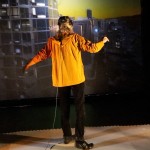
HyperJump flying to combat motion sickness
HyperJumping in Virtual Vancouver: Combating Motion Sickness by Merging Teleporting and Continuous VR Locomotion in an Embodied Hands-Free VR Flying Paradigm Motion sickness, unintuitive navigation, and limited agency are critical issues in VR/XR impeding wide-spread adoption and enjoyable user experiences. To tackle these challenges, we present HyperJump, a novel VR interface merging advantages ...

Concurrent locomotion and interaction in VR
Can more embodied and leaning-based interfaces help support concurrent locomotion and interaction in VR when physical walking isn't feasible? Physical walking is often considered the gold standard for VR travel whenever feasible. However, especially for larger-scale virtual travel the free-space walking areas are typically too small, thus requiring handheld controllers to navigate, which ...
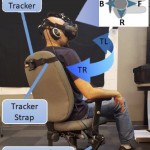
Leaning-based interfaces improve ground-based VR locomotion
Hand-held VR controllers are widely available and used, however they can contribute to unwanted side-effects, such as increased cybersickness, disorientation, and cognitive load. Here, we show how a leaning-based interfaces ("HeadJoystick") can help improve user experience, usability,and performance in diverse ground-based navigation including three complementary tasks: reach-the-target, follow-th...
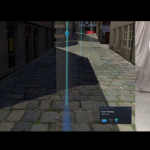
Integrating Continuous and Teleporting VR Locomotion into a Seamless "HyperJump" Paradigm
Here we propose a hybrid interface that allows user to seamlessly transition between a slow 'continuous' mode and a fast 'hyperjump' mode. The interface aims to maintain the immersion, presence, accuracy and spatial updating of continuous locomotion while adding the travel efficiency and minimizing the cybersickness. Continuous locomotion in VR provides uninterrupted optical flow, which mimics re...
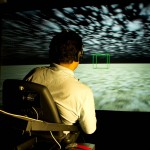
Lean and Elegant Motion Cueing in VR
How do we best design locomotion interfaces for VR that provide "enough" physical motion cues (vestibular/proprioceptive) while still being effective, affordable, compact, and safe? Despite amazing progress in computer graphics and VR displays, most affordable and room-sized VR locomotion interfaces provide only little physical motion cues (e.g., vestibular & proprioceptive cues). To provide...
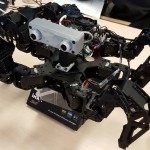
Immersive & Embodied Teleoperation Interfaces
Developing virtual interfaces for embodied tele-operation and locomotion. How can we best design and implement an embodied telepresence system for tele-robotics, so we can safely explore remote, hard-to-reach, or potentially hazardous areas or situations? The goal of the "TeleSpider" project is to design and implement a telepresence system where users can remotely operate a robotic spid...
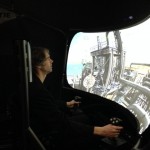
Motion Seats for VR
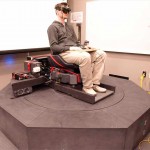
Using motion seats for enhancing locomotion and immersion in VR How can we provide a "moving experience" through VR without having to use a full-scale motion platform? Could a compact and relatively low-cost "motion seat" provide some of the same benefits, thus reducing cost, complexity, space & safety requirements? Despite considerable advances in Simulation and Virtual Real...
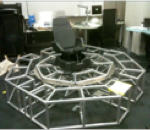
iSpaceMecha
Collaboration between the iSpace lab at SIAT and Mechatronics Undergraduate Interns to design and build a unique, virtual reality multi-modal motion simulator The iSpace program is centered on investigating what constitutes effective, robust, and intuitive human spatial orientation and behaviour. This fundamental knowledge will be applied to design novel, more effective human-computer interfaces ...
Spatial Updating With(out) Physical Motions?
How important are physical motions for effective spatial orientation in VR? Most virtual reality simulators have a serious flaw: Users tend to get easily lost and disoriented as they navigate. According to the prevailing opinion, this is because physical motion cues are absolutely required for staying oriented while moving. In this study, we investigated how physical motion cues contribute ...


