
Position:
Alumnus (MSc Student, graduated in 2018)
Contact:
tnguyenv [at] sfu.ca
http://nguyenvo.net/
Affiliations:
Biography
Thinh (Ted) has a BSc in Computer Science from HCMC University of Science. He stared an MSc at School of Interactive Arts and Technology (SIAT), Simon Fraser University in Fall 2016, and joined the iSPACE research lab, where he started his studies on VR technology and human spatial perception in immersive virtual environments. His research interests involve using technologies such as artificial intelligence, machine learning, virtual reality, augmented technology, to improve human life.
Projects
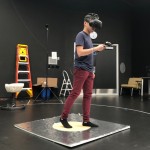
NaviBoard: Efficiently Navigating Virtual Environments
Here we propose a novel and cost-effective setup of a leaning-based interface ("NaviBoard") that allows people to efficiently navigate virtual environments - with performance levels matching the gold standard of free-space walking, without any increase in motion sickness Abstract Walking has always been the most common locomotion mode for humans in the real world. As a result, it has also been co...

Gamified Research
Gamifying Research - Researchifying Games While traditional experimental paradigms offer tight stimulus control and repeatability, then tend to be a bit boring and removed from many real-world situations, which can limit real-world transferability of results. How can we bring together the methodological strenghs of research with the intrinsic motivation of playfulness and gaming? The ...
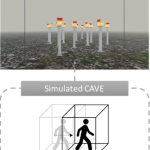
Navigational Search in VR: Do Reference Frames Help?
Would the rectangular reference frame of a CAVE help to reduce disorientation and improve navigation performance in VR? Here, we show that simply providing the rectangular reference frame of a room (as a simple wireframe cuboid), but not a CAVE improved navigational search performance. Despite recent advances in virtual reality, locomotion in a virtual environment is still restricted becau...
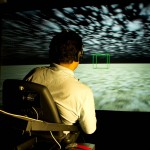
Lean and Elegant Motion Cueing in VR
How do we best design locomotion interfaces for VR that provide "enough" physical motion cues (vestibular/proprioceptive) while still being effective, affordable, compact, and safe? Despite amazing progress in computer graphics and VR displays, most affordable and room-sized VR locomotion interfaces provide only little physical motion cues (e.g., vestibular & proprioceptive cues). To provide...


