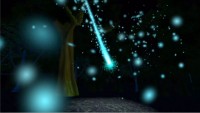
Do you get enough “awe” in your life? In our busy day-to-day lives, we often take our experiences for granted. While we have the technology to connect with one another, like smart phones, we don’t necessarily get outside with nature, or stargaze. Such activities may consist of common awe-inspiring moments, and we now understand that feeling awe is associated with all sorts of social and wellness benefits. But, how do we get more awe when it feels like our lives are getting busier, with light pollution that obscures the stars, and when travel may not be physically or financially feasible? With this research project, we are studying how we can design awe-inspiring virtual reality environments that are available for people to try, and what happens to people when they are inside these environments. From May 2016, we began undertaking the creation of a new immersive VR environment for inducing ‘awe’ in immersants.
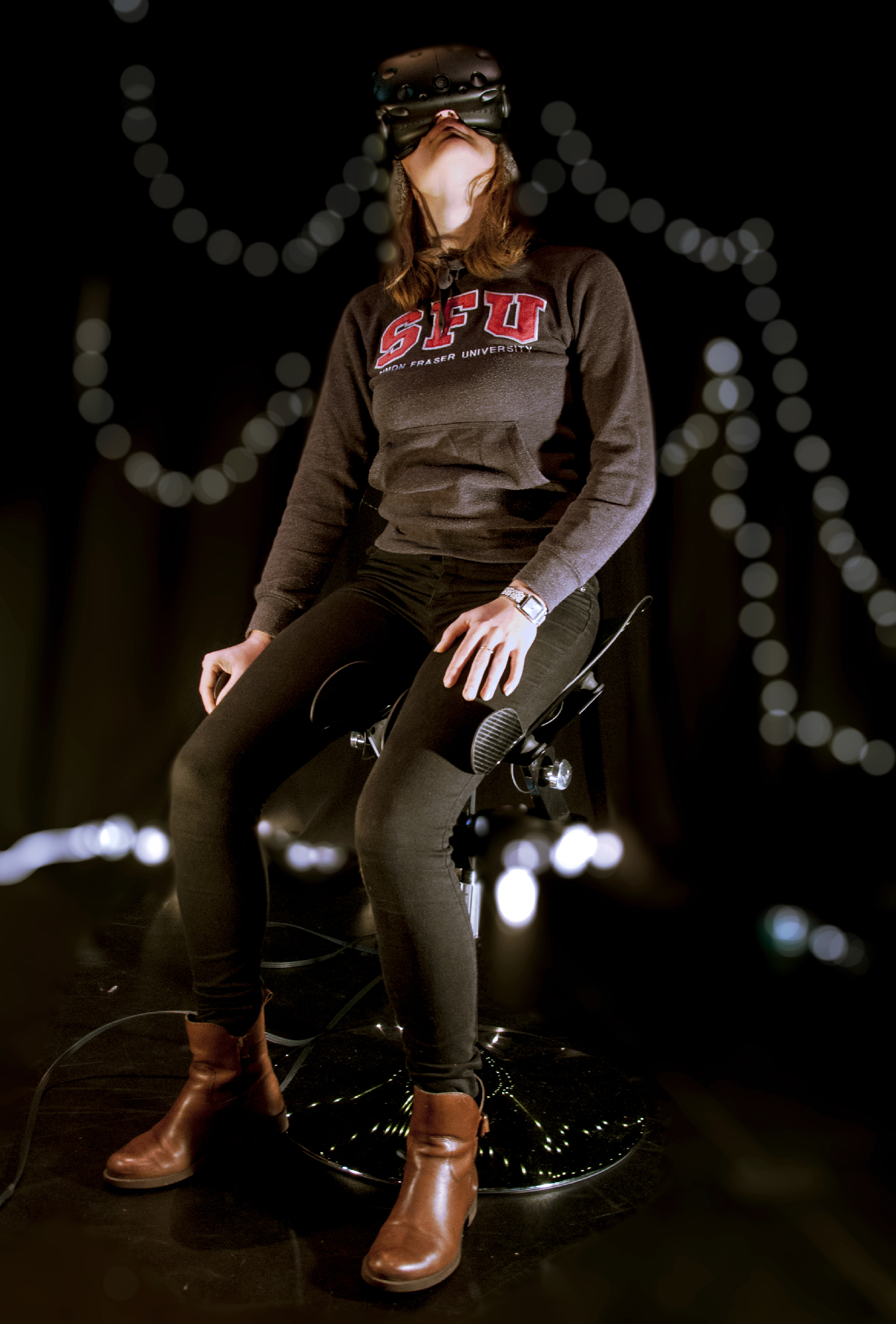
An immersant in our ‘AWE’ immersive VR environment, using the ‘Limbic Chair’ for navigation.
We recently published an analysis of this topic on The Conversation Canada: “Inspired, magical, connected: How virtual reality can make you well”, D. Quesnel, Nov 2017.
From Mount Everest to your childhood home- what do these two places have in common? They are both places you can virtually fly to in immersive Google Earth VR and have the experience of awe. We first presented findings in March 2017, where we learned that participants’ awe could be validated through a physiological indication of raised goose bumps on the skin, often accompanied by ‘frisson’, a pleasant sensation of chills. Many people know ‘frisson’ from listening to music and from watching powerful scenes in movies. As it turns out, this physiological measure is a great indicator of a moment of felt awe, and is even more powerful when we use systems like VR that involve many senses. In our studies, it turns out that these goose bump inducing moments also correlated with high ratings of awe among participants. Have a look at our brief video below for the IEEE VR 3D User Interface Symposium for more information.
Perhaps, VR could make experiences of awe more available to people who need them.
Using our knowledge on awe in VR, we opted to create an ‘awe-inspiring wellness environment (AWE)’ with our partners at the Centre for Digital Media in Vancouver. Between the iSpace Lab and a team of Masters of Digital Media cohort, we iterated a prototype VR environment that takes an immersant on a journey through time and space. The environment doesn’t use hand controllers or complicated game mechanics to navigate, and features a scene that allows for full environment exploration, and also guided scenes where the immersant is led. Immersants simply lean in the direction they wish to go.
Many immersants report feelings of personal connection to the guide, which is a mysterious creature of light. During the experience’s climax, immersants have reported deep thoughts about their place in the world. We have a lot of work to do with the environment, as we aim to re-iterate with our participants in the community through the process of co-creation. Our goal is that our subsequent environment in 2018 will allow for even more exciting, intuitive interfaces, and yet more awe-inspiring features.
We continue to work on our EarthGazing research, which aims to study the ‘Overview Effect (OE)’ in VR. The OE also encompasses awe as part of the spectrum of emotions that may help shift perspectives.
[vimeo 201083373]
Below is Alex’s presentation on “Designing Mind(set) and Setting for Profound Emotional Experiences in Virtual Reality” from DIS ’20:


