
Biography
Abraham is a Ph.D. student in School of Interactive Arts & Technology (SIAT) at Simon Fraser University (SFU) with a background in computer science. He is interested in UX/UI research in virtual, augmented, and mixed realities. Moreover, he is interested in immersive game design regarding his knowledge and prior experiences.
Background: After finishing his M.Sc. in Artificial Intelligence (AI) at 2003, Abraham taught for 12 years as a university instructor, while focusing on game design (for the first 5 years) and Holographic interface design (for the next 5 years) as his field of research. In 2015, he started his Ph.D., focusing on designing interfaces for navigation within virtual environments. Please check his personal website for more details.
Projects

Concurrent locomotion and interaction in VR
Can more embodied and leaning-based interfaces help support concurrent locomotion and interaction in VR when physical walking isn't feasible? Physical walking is often considered the gold standard for VR travel whenever feasible. However, especially for larger-scale virtual travel the free-space walking areas are typically too small, thus requiring handheld controllers to navigate, which ...
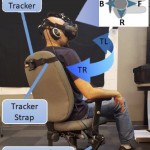
Leaning-based interfaces improve ground-based VR locomotion
Hand-held VR controllers are widely available and used, however they can contribute to unwanted side-effects, such as increased cybersickness, disorientation, and cognitive load. Here, we show how a leaning-based interfaces ("HeadJoystick") can help improve user experience, usability,and performance in diverse ground-based navigation including three complementary tasks: reach-the-target, follow-th...
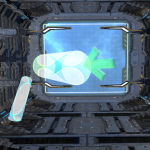
Embodied & Intuitive Flying for VR, Gaming, and TeleOperation
Flying has been a dream for mankind for millenia - but flying interfaces for VR, gaming, and teleoperation (e.g., drones) typically rely on cumbersome double-joystick/gamepads and do not allow for intuitive and embodied flying experiences. Here, we develop low-cost embodied flying interfaces that adapt leaning-based motion cueing paradigms thus freeing up hands for additional tasks beyond just na...

Gamified Research
Gamifying Research - Researchifying Games While traditional experimental paradigms offer tight stimulus control and repeatability, then tend to be a bit boring and removed from many real-world situations, which can limit real-world transferability of results. How can we bring together the methodological strenghs of research with the intrinsic motivation of playfulness and gaming? The ...
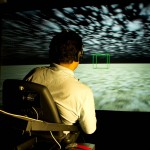
Lean and Elegant Motion Cueing in VR
How do we best design locomotion interfaces for VR that provide "enough" physical motion cues (vestibular/proprioceptive) while still being effective, affordable, compact, and safe? Despite amazing progress in computer graphics and VR displays, most affordable and room-sized VR locomotion interfaces provide only little physical motion cues (e.g., vestibular & proprioceptive cues). To provide...
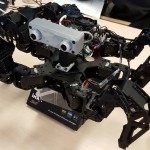
Immersive & Embodied Teleoperation Interfaces
Developing virtual interfaces for embodied tele-operation and locomotion. How can we best design and implement an embodied telepresence system for tele-robotics, so we can safely explore remote, hard-to-reach, or potentially hazardous areas or situations? The goal of the "TeleSpider" project is to design and implement a telepresence system where users can remotely operate a robotic spid...
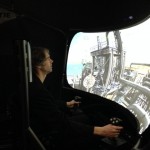
Motion Seats for VR
Using motion seats for enhancing locomotion and immersion in VR How can we provide a "moving experience" through VR without having to use a full-scale motion platform? Could a compact and relatively low-cost "motion seat" provide some of the same benefits, thus reducing cost, complexity, space & safety requirements? Despite considerable advances in Simulation and Virtual Real...


