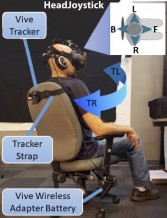
Hand-held VR controllers are widely available and used, however they can contribute to unwanted side-effects, such as increased cybersickness, disorientation, and cognitive load. Here, we show how a leaning-based interfaces (“HeadJoystick”) can help improve user experience, usability,and performance in diverse ground-based navigation including three complementary tasks: reach-the-target, follow-the-path, and racing (dynamic obstacle avoidance).
[mediatags]proj–HeadJoystick[/mediatags]
Publications
Below are videos explaining the tasks, stimuli and methods used
Reach-the-target task
using Controller
using HeadJoystick
Follow-the-path task
using Controller
using HeadJoystick
Racing (dynamic obstacle avoidance) task
using Controller [youtube JyI6MJDjJUE
using HeadJoystick .
Study 3 reach-the-target task (with optional brake)
using Controller
using HeadJoystick
using HeadJoystick with Brake


