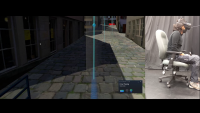
Here we propose a hybrid interface that allows user to seamlessly transition between a slow ‘continuous’ mode and a fast ‘hyperjump’ mode. The interface aims to maintain the immersion, presence, accuracy and spatial updating of continuous locomotion while adding the travel efficiency and minimizing the cybersickness.
Continuous locomotion in VR provides uninterrupted optical flow, which mimics real-world locomotion and supports path integration . However, optical flow limits the maximum speed and acceleration that can be effectively used without inducing cybersickness. In contrast, teleportation provides neither optical flow nor acceleration cues, and users can jump to any length without increasing cybersickness. However, teleportation cannot support continuous spatial updating and can increase disorientation. Thus, we designed ‘HyperJump’ in an attempt to merge benefits from continuous locomotion and teleportation. HyperJump adds iterative jumps every half a second on top of the continuous movement and was hypothesized to facilitate faster travel without compromising spatial awareness/orientation. In a user study, Participants travelled around a naturalistic virtual city with and without HyperJump (equivalent maximum speed). They followed waypoints to new landmarks, stopped near them and pointed back to all previously visited landmarks in random order. HyperJump was added to two continuous locomotion interfaces (controller and leaning-based). Participants had better spatial awareness/orientation with leaning-based interfaces compared to controller-based (assessed via rapid pointing). With HyperJump, participants travelled significantly faster, while staying on the desired course without impairing their spatial knowledge. This provides evidence that optical flow can be effectively limited such that it facilitates faster travel without compromising spatial orientation. In future design iterations, we plan to utilize audio-visual effects to support jumping metaphors that help users better anticipate and interpret jumps, and use much larger virtual environments requiring faster speeds, where cybersickness will become increasingly prevalent and thus teleporting will become more important.
Publications
Related work
full 3D (flying) HyperJump
For an application of HyperJump to 3D (flying) locomotion and in larger scenes, see our HyperJump flying to combat motion sickness project website.


